
In his essay, “Why I Am Not A Christian,” atheist philosopher Bertrand Russell criticizes Jesus for having a “moral problem.” He cites a passage from Mark 11 where Jesus was hungry and went to check out a leafy fig tree, only to find it was devoid of fruit “because it was not the season for figs.” In response, Christ said, “May no one ever eat fruit from you again.” And sure enough, the next day, the tree had withered. Russell finds this pathetic if not contemptible, saying,
This is a very curious story, because it was not the right time of year for figs, and you really could not blame the tree. I cannot myself feel that either in the matter of wisdom or in the matter of virtue Christ stands quite as high as some other people known to history. I think I should put Buddha and Socrates above Him in those respects.
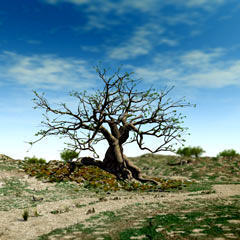
Though it takes a lot of brass to count oneself morally superior to Jesus, Russell at least takes the story at face value. Not so some preachers and theologians who deny it out of embarrassment. Yale’s late preaching professor Halford Luccock said he didn’t blame Luke for leaving it out of his Gospel account; Duke’s late divinity school dean Harvie Branscomb denied its plausibility, saying, “Jesus scarcely went about blasting fruit trees simply because they did not have fruit ready for Him at the moment”; the late Scottish minister/professor William Barclay observed, “To us there seem insuperable difficulties in taking it literally.”
Fortunately, we have centuries of scholarship which assumes the truth of the Bible, and which finds Jesus not at all short of “wisdom” and “virtue” in this tree encounter. First, for the “wisdom”: a number of commentators have affirmed the rationality of seeking something edible from this leafy tree “out of season.” For instance, 19th-century British preacher Charles Spurgeon said that “according to the natural order of production the fig-fruit precedes the foliage”; his contemporary Alexander Maclaren said that “experts tell us that in the fig-tree the leaves accompany, and do not preceded the fruit”; 20th-century Bible scholar William Lane (New International Commentary) drew from earlier scientific texts on Palestinian flora to write that “early green figs, which actually appear before the leaves” can be found in springtime. Sometimes they fall off; at any rate, they’re not so tasty. But, as Alan Cole of the Tyndale commentary suggested, “It is fair to say that presumably,” Jesus, in his hunger, “was looking for the small early ripe figs, that ripen with the leaves.” So yes, a man with “wisdom” might well expect to find something there.
As for Jesus’ “virtue,” note that the text doesn’t say Jesus was petulant. Nor does it suggest that he’d destroyed someone’s property; this was just a roadside tree, not an orchard fixture. And though this event stands out as Jesus’ only act of miraculous destruction in the Gospels, the “victim” was, after all, only a tree. If, in contrast, Jesus had asked a blind man to read something, and then he turned on him when he couldn’t, that would be troubling. But that’s not what happened.
Rather, the Lord found a teachable moment in the traffic patterns of life. In this case, most agree that He performed an action parable, critiquing fruitless religious leaders with a leafy display of ceremony and piety. And when the disciples wondered at His power to speak destruction, He talked to them of faith. For comparison, imagine that had he been gathering firewood and was surprised by scurrying insects who’d been hidden under a fallen log. He might have said something about those who hated the light and then killed the “innocent” bugs with a withering declaration, thus picturing the destruction to come.
In the end, there are two broad ways to approach the fig-tree encounter, both beginning with the question, “Why did He do that?” British Lord and Nobel Laureate Bertrand Russell and his acolytes ask it rhetorically, accusingly, and dismissively. Believers ask it genuinely, reverently, and expectantly, secure in the knowledge that there is a good and honorable answer. Furthermore, they take to heart the Lord’s teaching that a show of churchiness and grand religious talk mean nothing if no Kingdom fruit can be found in their lives.